

Hello again,
So, if you’ve been reading these posts (thank you by the way!) you might have noticed by now a heavy emphasis on how the brain and the nervous system work in general. That is on purpose.
A big part of therapy is what we call “psycho-education.” The more you know about what’s going on inside of you, the more work you and your counselor can accomplish in each session, which is what we want, right?
Counseling is unique in that we don’t want a doctor/patient kind of dynamic, where the counselor is the expert on everything. First of all, you are and will always be the expert on you. However, as time goes by, the dynamic will shift with the therapist getting to know you better, and you growing in your understanding of the nervous system, your diagnosis, and effective interventions, thus giving you and your therapist a more balanced and collaborative relationship.
So no, you do not need to go back to school and get a degree in some mental health field, but a working body of knowledge will have a significant positive impact on the kinds of connections and discoveries made in each therapy session. So for today, let’s discuss the important concept of “Neurons that fire together, Wire together.”
What the Phrase Means
This theory, known as Hebbian theory, was proposed by Canadian neuropsychologist Donald Hebb explaining how cells adapt, or how changes are made in the human body, and how habits are formed on a cellular level – pretty cool right? The short memorable phrase of “neurons that fire together, wire together” wasn’t coined until 1992 by neurobiologist Dr. Carla Shatz, but the phrase was meant to help us laypeople understand Hebbian Theory on Cellular Adaptation.
When Neuron A is activated and fires a message off to Neuron B, these two neurons are now connected. Now, let’s say this relay of Neuron A firing a message off to Neuron B happens over and over and over again. For example, let’s say the first thing you do when you get home from work is put on comfy clothes, grab your snack of choice and the remote, and fall into the couch ready to watch your current show of choice. Relaxation mode is ON. Over time, as this messaging gets repeated, the connection between the two neurons grows stronger. As the connection grows, the relayed message gets faster and stronger, which is then why whatever the habit may be, in this case, getting comfy and watching TV, the behavior now feels like what we call “autopilot.” We don’t even have to think about it and we just do the behavior automatically.
Now, if we want to be super technical, the wiring together doesn’t mean these two neurons now fire at the same time, but more the “wiring together” signifies the strength and the speed of the connection between the two neurons.
So what does this apply to? Anything and everything, take your pick. The good news about this, is with this information, we now have ways and means of disrupting old habits and creating new ones. We simply have to implement strategies that disrupt the pattern, and thus changes the wiring.
So, if this interests you, and you want to learn all the best tips and tricks on ways to change those synapses, to make good habits easier and make bad habits harder to maintain, the book that has all that information spelled out in a clear, easy to understand format is, in my opinion, Atomic Habits by James Clear.
The Four Laws for Building a Better Habit:
- Make it obvious
- Make it attractive
- Make it easy
- Make it satisfying
The Four Laws for Breaking a Bad Habit:
- Make it invisible
- Make it unattractive
- Make it difficult
- Make it unsatisfying
So let’s use our example of immediately switching to relax mode after work, when you’d like to go for a long walk with your dog. We can use the 4 laws above to spell it out.
Make it Obvious (New Habit) / Make it Invisible (Old Habit)
Put walking clothes, plus your dog leash and walking shoes right on the couch where you’d normally sit down to veg, while also putting the remote in a drawer.
Make it Attractive / Make it Unattractive
Pick a funny podcast or book you’ve been wanting to read (or in this case, at least listen to) and we’re gonna use this time to do the fun thing we don’t normally get to do, and maybe a ball to play fetch, (the term for this is temptation bundling FYI). Meanwhile, you will also be putting a sign on your TV that reads (if I remove this sign right after work, I am choosing the old instead of the new – ouch!) making it both unattractive and a little harder to follow through on it.
Make it Easy / Make it Difficult
Bring some treats in case your dog isn’t used to a long evening walk and needs some coaxing. Maybe not, but if you know your dog will also need some convincing, let’s give them a good motivator so we’re not making this dog walk harder for us too. Plus, we are not going to drive across town to the best dog park right from the get-go, we’re going to simply walk out the door and get used to the evening walk being the first thing we do after work. Next, if hiding the remote and putting a sign on the TV still isn’t enough, unplug the TV and/or remove the batteries from the remote.
Make it Satisfying / Make it Unsatisfying
Lastly, once you have completed the walk of the evening, even if it was just five minutes for whatever reason, you did the new thing! Give yourself a reward! Now if you are trying to live healthier in general, this doesn’t mean you need to have a dessert every day, or if you’re trying to be financially responsible, you don’t need to go buy something for every walk either, we want your rewards to be in alignment with all your life goals/values.
Now if you’re thinking, “But desserts and impulse purchases are my favorite! (Mine too!) What else can we do??” Well, in case you didn’t know this yet, but we humans…we LOVE tracking…who isn’t somewhere between mildly to severely crushed when they lose their streak on Duolingo or whatever app you’re using? When we see our progress on display, it motivates us to keep going. So make a little check on your calendar, or make a chart specifically for this habit, whatever suits you.
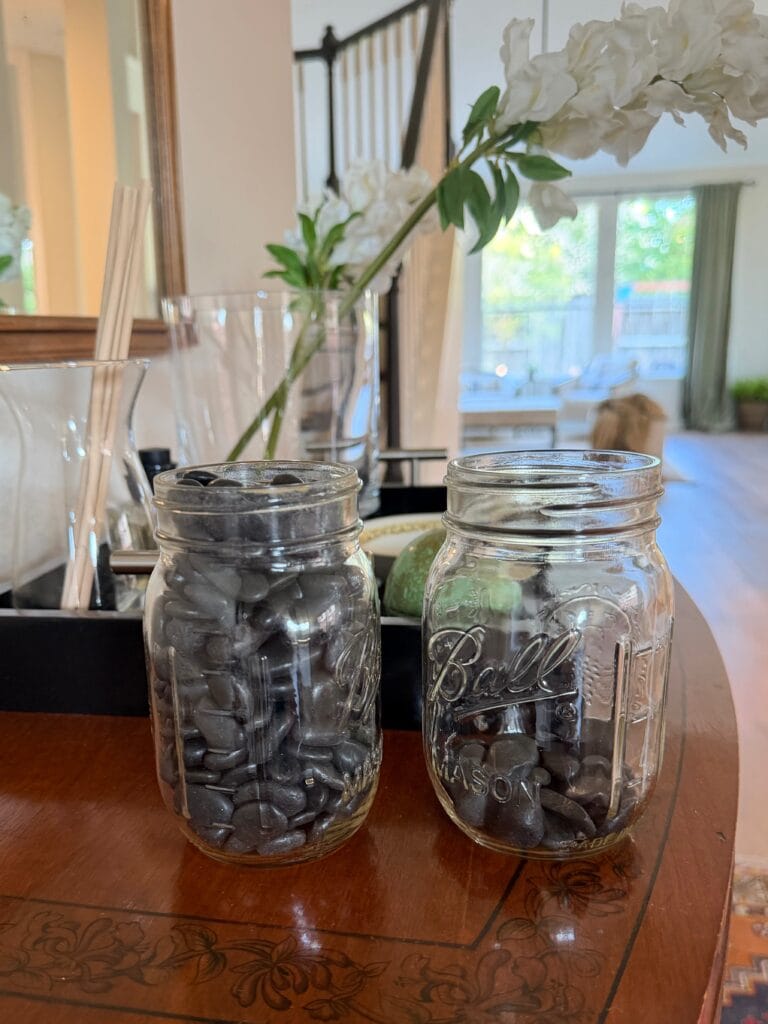
Personally, I love having two jars, one filled with smooth stones and one empty. If I’m practicing a new skill/habit, every time I do the thing, I get to move one stone from the jar filled with stones, to the empty jar. I love this because first of all, I love how the stones feel, but also because it’s such a good representation of what is actually happening inside my brain as I go along. For a while it will feel like nothing is getting easier, that each time, I still have to actively choose the new habit (See Stages of Competence if you’re interested). But on the inside, I am slowly weakening the neurons that are currently firing together, and slowly increasing the strength and connection of the neurons that are being wired together.
As far as making it unsatisfying, this is where there needs to be some kind of immediate cost every time you choose the old unwanted behavior. Maybe ask a friend to be willing to be your accountability partner, and every time you do the walk, send a selfie! And if you don’t, you need to text them that you didn’t do it. Or, on that calendar or habit tracker, when the new habit is skipped, put a big red “X” or a frowny face.
For those who like to take things to the extreme, I once read about someone, who in order to quit smoking, asked a friend to make a donation to an organization that he DOES NOT SUPPORT in his name should he cave and smoke a cigarette. He gave his friend X amount of dollars that he trusted him to hold onto, and every time he lit a cigarette, he had to tell his friend, and then the NRA got a $20 donation in his name – DAMN. You don’t have to go that far, but you get the gist.
So there you have it, the step by step breakdown of behavioral change to break an old habit and build a new one. If you want to dig deeper, by all means get the book and have at it!
But what we can take from all this is, we know what kinds of activities cause neurons to be wired together, which means we know the kinds of things to do that can change the wiring. Why do I love this so freaking much??? Because it spells out the message of “Change is Possible.”
So whatever it may be…getting to work on time, leaving work on time, writing blog posts on a regular and consistent basis (yeah you guessed it, that one’s for me), we can make it happen.
And remember, you are a worthy investment. You are worth the time and effort it takes to learn and grow. Feel free to share below what habit you want to work on and we can grow together 🙂
In Solidarity,


Leave a Reply